

A Nation of Builders
The United States is a nation of builders. American national power is not a result of our prowess at financial engineering, legal sophistication, or entertainment. Rather, we are a nation of people who build things that are excellent, ingenious, and better. Despite decades of decline, manufacturing remains a huge and essential part of our economy. It employs more than 12 million men and women, roughly 8 percent of U.S. employment, according to the Bureau of Labor Statistics.
Most of us are familiar with household brands and large multinational manufacturing corporations. What is less well known is the extent to which manufacturing is done in close collaboration between companies across a supply chain. Original equipment manufacturers rely upon a vast network of small and medium-sized businesses that together build the materials, parts, and subcomponents inside every end item.
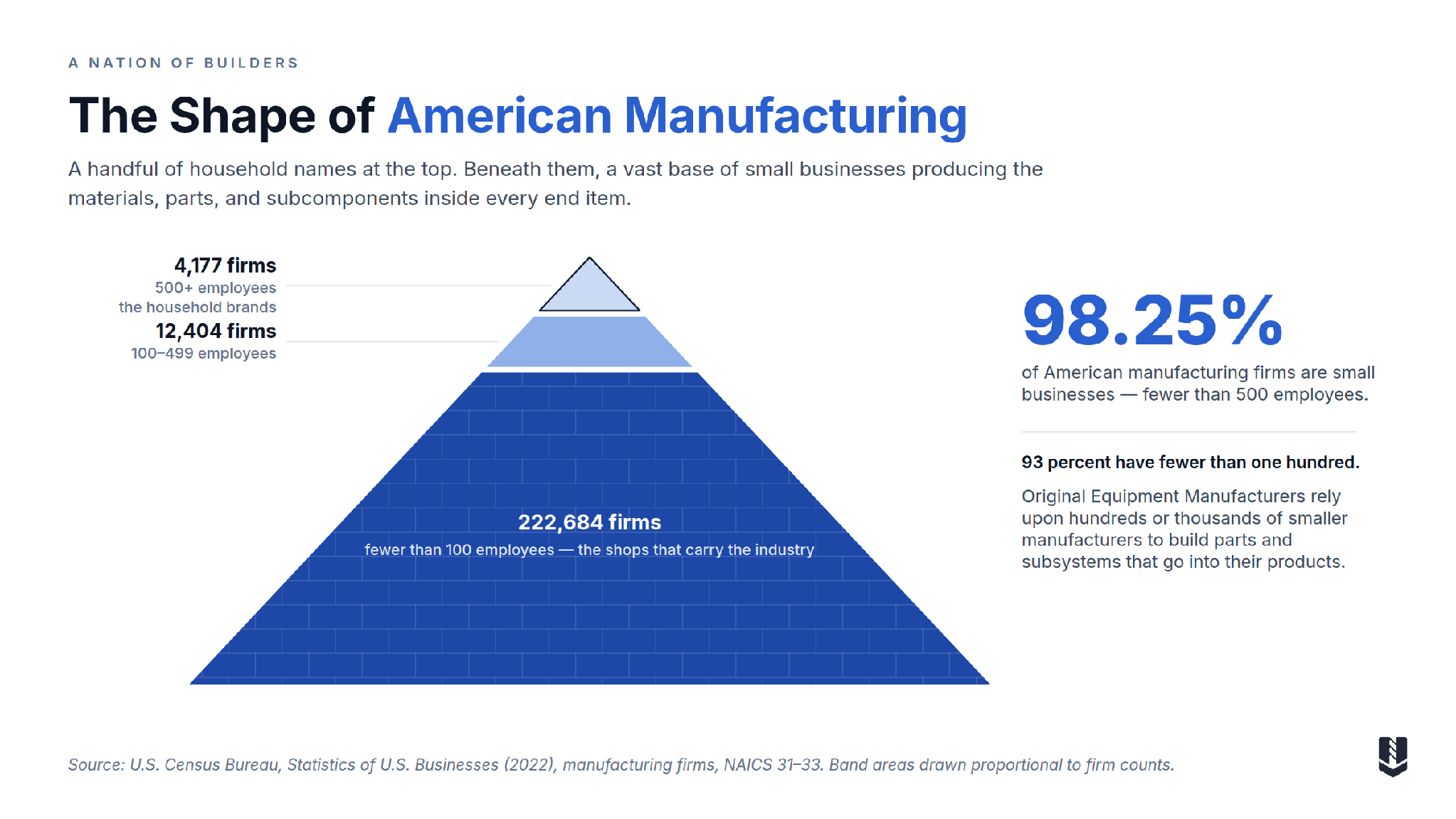
According to the Census Bureau’s County Business Patterns, there were roughly 284,000 manufacturing establishments operating in the United States as of 2023, and Census statistics on firm size show that more than 98 percent of American manufacturing firms fall below the 500-employee small business threshold (2022 data). Everyone knows the household brands, but almost no one knows the quarter million businesses inside the supply chains that make them possible.
These businesses are the foundation of American manufacturing, and the success of every manufacturer relies on its ability to find, qualify, and develop its supply base.
The Moment Has Arrived
Geopolitical risk and advancing technology have changed the calculus for global supply chains. As a result, we are in the early phase of a generational transformation toward more localized and resilient distributed manufacturing operations. Reindustrialization has become a key element of national policy, corporate strategy, and capital allocation, and has proven to be a durable bipartisan project.
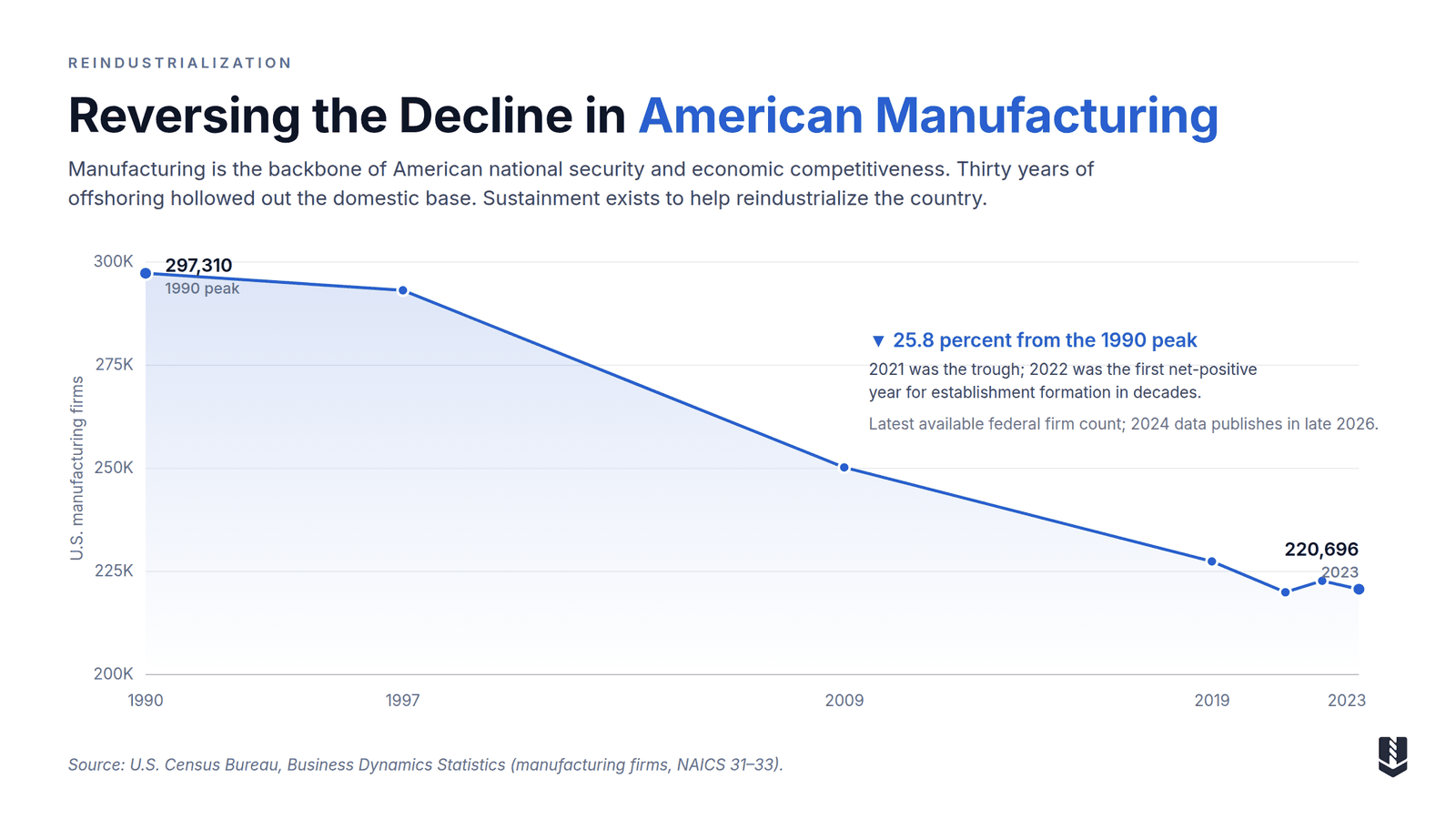
The data reflects both how far we drifted and how much work remains. Manufacturing has fallen from 13.1 percent of GDP in 2005 to 9.4 percent today, according to the Bureau of Economic Analysis. Census Business Dynamics Statistics show roughly 26 percent fewer manufacturing firms in 2023 than at the 1990 peak. China has grown to roughly 30 percent of global manufacturing value added, up from about 6 percent in 2000, and the UN Industrial Development Organization projects it will reach 45 percent by 2030. The United States has moved in the opposite direction, falling from roughly one quarter of global manufacturing value added in the early 2000s to about 15 percent today, and the same UNIDO analysis projects the American share will fall to 11 percent by 2030.
We have work to do, but there are positive developments underway. Census trade data shows China falling from 13.4 percent of U.S. goods imports in 2024 to 7.3 percent in the first five months of 2026, with North American manufacturing suppliers absorbing much of the shift.
Intent Is Not Capability
The desire to build here is real and measurable. In America’s New Industrial Blueprint, a 2025 survey of manufacturing leaders we conducted with the New American Industrial Alliance, 71 percent said they planned to increase spending with U.S. suppliers. However, only one in ten said they could rely entirely on U.S.-based suppliers if they chose to. The remaining 90 percent reported that full domestic sourcing is either nearly impossible or not financially viable, even if they wanted to pursue it. Both findings are true, and the gap between them is the actual size of the problem.
To be sure, this is not an argument that all production should return to the United States. Localized does not mean one hundred percent American, and a resilient supply chain will continue to include trusted international and nearshore suppliers. Rather, the work of our generation is to rebuild enough domestic capability, capacity, and connectivity that choosing an American supplier is a competitive decision, not a patriotic gesture.
The Coordination Problem
American manufacturing is one of the most fragmented industries in the world: hundreds of thousands of manufacturers, millions of transactions, and no shared system for coordinating the work between them. Buyers on both commercial and defense supply chain teams manage sourcing operations through legacy systems, spreadsheets, email threads, and institutional memory. Suppliers win work through relationships and reputations that often do not extend beyond the regional or industry silo in which they grew up.
And that institutional memory is aging out in many cases: when a buyer with forty years of experience retires, the knowledge of who can hold a tolerance, who quotes quickly, and who delivers on time retires with them. Many companies still tell us it is easier to find a manufacturing partner in China than it is to find one in their county or state. This is often a coordination problem, not a capability problem.
The size of supply chain spend makes coordination a strategic matter. By our calculation from the Census Bureau’s Annual Integrated Economic Survey, cost of materials runs about 58 percent of manufacturing shipments (2023 data), which makes purchased inputs the largest line on the average manufacturer’s P&L, larger than labor and capital combined. This demonstrates that sourcing is not an administrative function; it is a strategic pillar of the business.
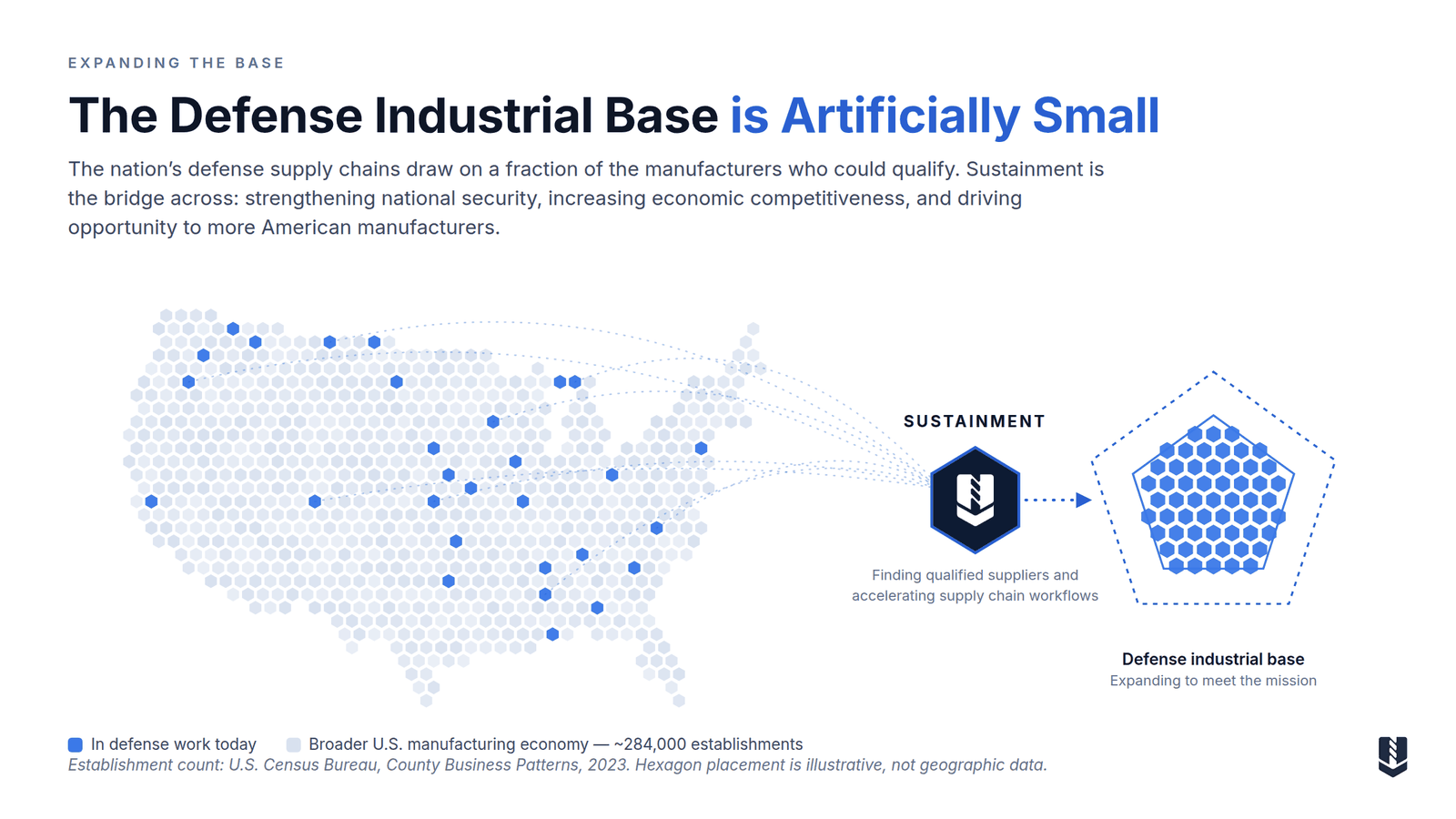
On the defense side, the industrial base itself is thinning: the SBA’s procurement scorecard shows the number of small businesses holding prime contracts with the Department of War fell nearly 14 percent between FY2020 and FY2025, even as small-business dollars rose. Fewer suppliers are carrying more of the load as defense manufacturing requirements increase amid global conflict. The nation’s defense supply chains draw on a fraction of the manufacturers who could qualify. For defense organizations, this is a real, immediate problem, as supply chain readiness is mission readiness in many cases.
A System of Action
We built Sustainment to solve this problem. Our conviction is that by aligning incentives and generating real economic value across all participants, we can both build a huge business and be a force for good for manufacturers across the country.
For commercial organizations, Sustainment is how supply chain teams move faster, spend smarter, and build resilience. Our software helps strengthen existing supplier relationships, find new ones across America’s largest verified network of manufacturers, and reduce direct costs by putting more qualified suppliers on every RFQ.
For defense organizations, Sustainment is how supply chain teams increase speed and throughput while expanding the defense industrial base by matching manufacturing requirements to qualified sources of supply. These two markets strengthen the same network. Every commercial transaction adds capability, data, and readiness to the industrial base the nation will call upon in a crisis.
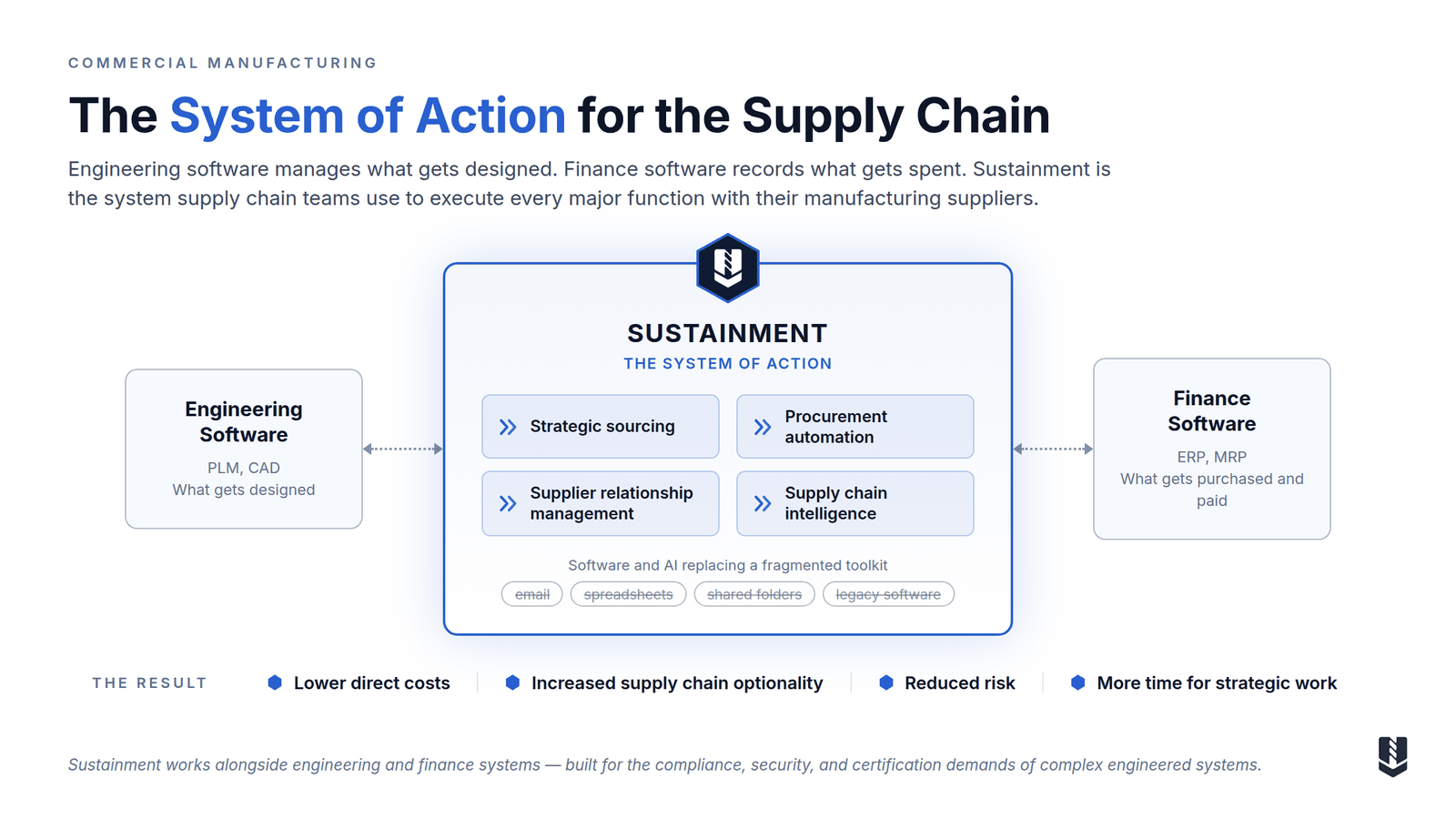
None of it works without the suppliers themselves. For American manufacturing suppliers, Sustainment is free, and keeping it free is a commitment we made when we organized as a Public Benefit Corporation. Suppliers use Sustainment to show what they can build, connect with new customers, and compete for work that once flowed offshore or defaulted to the incumbent. Today that network includes more than 120,000 American manufacturers.
We are also proud to partner with over 100 manufacturing support organizations at the local, state, and federal levels. You know these groups as local associations, state-level Manufacturing Extension Partnerships, and national trade groups. Sustainment helps these organizations develop and manage relationships with manufacturers so that they can provide programming and services to help the manufacturing economy develop and invest in new technologies.
The Work in Front of Us
This transformation will be built by many hands, and each of our constituents has a role in it.
To commercial supply chain teams: Treat supply chain and sourcing operations as the strategic pillar it has become. The era of fully globalized supply chains is over. Build your sourcing strategy for the world that is coming, not the world that was.
To defense supply chain teams: Our warfighters can and must be supported by the full strength of the national industrial base. Mission success will belong to the organizations that can quickly find, qualify, and mobilize new manufacturing capacity.
To manufacturing suppliers: More demand is coming, and the advantage will go to the shops that invest in people, technology, and scale. Be aggressive and lean into this moment.
To manufacturing support organizations: The Manufacturing Extension Partnerships, trade associations, and economic developers who champion small and medium-sized manufacturers are force multipliers for the entire industry. Prepare your members for the demand that is arriving.
To government leaders: Treat manufacturing as a strategic national asset, all the way down the supply chain. Manufacturers are not asking for protection. They are asking for streamlined, predictable, and proportionate regulation, and for programs that help small and medium-sized manufacturers access capital, talent, and technology.
Building with Purpose
We are on a mission to strengthen the capability of the American manufacturing economy for the benefit of all participants, including buyers, suppliers, and government organizations that both support and rely upon manufacturing.
That mission rests on the dedicated, skilled men and women who make up the American industrial base. Companies are people. The things we build have value because of the people who build them and the people they serve, and helping people remains the essence of American exceptionalism.
Rebuilding our industrial base is generational work, and it will at times be slow and messy. Fortunately, we have the builders, the technology, and a rare alignment of commercial incentives and national imperatives.
The time is now. Let’s get to work.