

Direct procurement is being rebuilt around AI, as is nearly every function in American industry. However, The Hackett Group's 2026 Procurement Key Issues study found that 43% of procurement organizations are deploying AI, and only 12% have reached scale.
That gap was visible at the KonnectHouse Direct Procurement Summit in Chicago this week. Shashi Mandapaty, former CPO and the summit’s opening keynote, asked the room whose working life had been changed by AI. Only a few hands went up.
We are still in the early phase of this transformation, and companies are taking different approaches to bringing these technologies into an increasingly complex supply chain.
Few functions are better suited to AI than direct procurement for complex engineered equipment. In our work with industrials, a typical manufacturer runs about 500 active suppliers, and larger OEMs work with thousands. Each supplier generates quotes, POs, certs, ship dates, and capability data, and all of it changes constantly. Supply chain has always been a data problem at scale.
Direct Procurement Runs on People
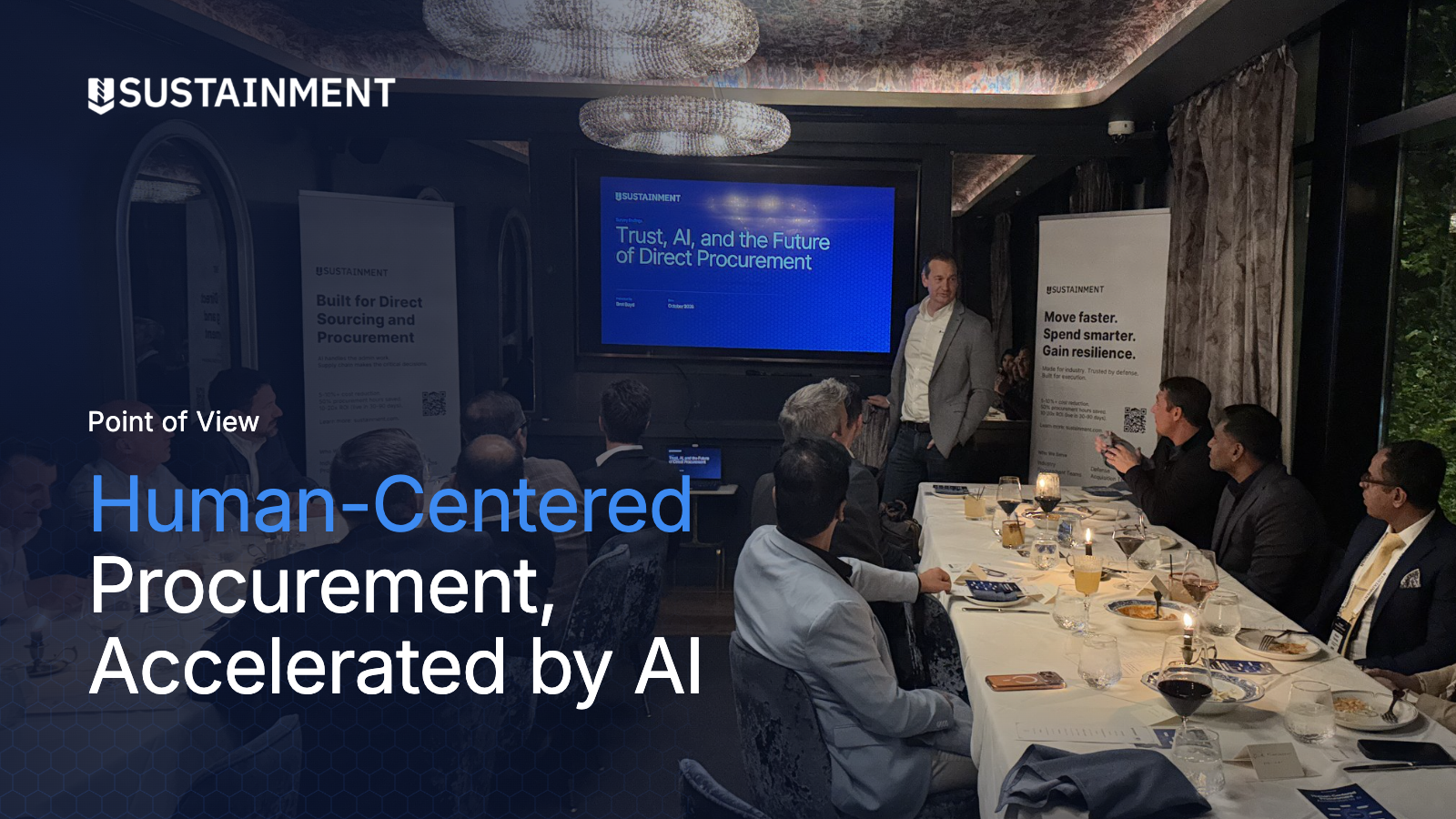
On the sidelines of the summit, we hosted a salon dinner for procurement and supply chain leaders to take the pulse of the industry on how AI should be put to work in direct procurement. We titled the discussion “Trust, AI, and the Future of Direct Procurement.”
Our pre-event survey of attendees showed an industry that wants AI to accelerate its people and supplier relationships, not replace them. Nearly two-thirds (63%) said a personal relationship with the supplier resolved their last major disruption. Even more (88%) said the commitment that mattered, pulling in a date or holding capacity, came from a specific person they know. One attendee put the limit of the technology plainly: “AI will never build a relationship that matters with our vendors.”
What Leaders Would Hand to AI
Asked what they would hand to AI tomorrow, 88% chose supplier quote comparison. Cleaning up master data, finding suppliers before an RFQ, and PO follow-up emails drew 63% each. Half chose certification tracking, and in discussion several execs described compliance work, such as onboarding a supplier, as mostly box-checking that does not drive business value. That makes it a natural first candidate for AI.
Leaders are comfortable with AI on analysis and paperwork and cautious when it speaks for them. What the room wants today is a “super smart MBA intern” that has worked through all the data, drafts three emails, and leaves the buyer to read them, tweak them, and hit send. Agentic phone calls on POs drew only 25%, and supplier fatigue is part of the reason. Many suppliers have stopped answering after repeated RFQs with no follow-through, and a robot calling every day will likely not bring them back.
The Right Tool for Each Supplier
The line on autonomy was just as clear. Asked which decisions AI should not make without human approval, 88% named dropping or switching a supplier, 75% named negotiating pricing and awarding business, and 63% named communicating a quality issue. Only 13% would let AI handle all four alone. Accountability explains much of this, since 63% said the department leader answers for an AI sourcing decision that goes wrong.
The most useful idea of the evening came out of this part of the discussion. The line between human and AI work runs through direct procurement itself, beyond the usual split between direct and indirect spend. The discussion framed it in terms of ABC classification. C items, such as fasteners and other commodity parts, can run AI-first, with automated RFQs, follow-ups, document collection, and status checks, and a buyer stepping in on exceptions. A items, such as a robotic arm or a component tied to patient safety in a medical device, warrant human oversight backed by AI-enabled decision support. The same logic applies to the supply base, where a core of 50 to 150 suppliers typically carries most of the spend at a mid-size OEM. The point the room landed on was to match the tool to the job, based on the risk and strategic significance of each item and supplier.
When AI Talks to AI
The room also debated how and when that line will move. Suppliers are starting to deploy agents of their own, and attendees were more comfortable with AI doing parts of their own job than with suppliers using it on them. The room split on whether they would accept a ship date or capacity commitment from a supplier’s AI agent.
Only 13% think fully autonomous sourcing is realistic within five years. By all appearances, we are moving towards a world where a buyer’s agent works routine terms with a supplier’s agent, and the share of the supply base managed AI-first will grow as both sides build trust in the outputs. The critical discipline is to not outpace the market in terms of technology and practicality. These businesses must evolve, but at a pace that remains realistic, where AI appropriately interacts with their data, systems, processes, and relationships. Data quality and trust in AI outputs were the barriers attendees cited most often. Both are solvable, and neither is solved by removing the people who hold the relationships. Teams that stay flexible on where they draw the line, and conservative on decisions that could damage a key supplier, are positioned to capture the gains without betting the business.
More Time for the Work that Matters
One attendee reframed the evening’s question. The better question is not where AI should make decisions, but where it can give buyers their time back. When we asked what buyers would do with 10-20 hours a week back, three-quarters chose risk mitigation and dual-sourcing, 63% chose supplier development, and at least half chose strategic negotiations. In other words, the time goes back into resilience and relationships.
On the topic of AI replacing jobs, most in the room voiced confidence in leveraging AI to move faster and make decisions with more intel readily available. Nearly nine in ten (88%) disagreed that their leadership sees AI mainly as a way of reducing headcount.
Getting this right matters because of what direct procurement controls. Census Bureau data show that purchased materials account for about 58% of the value of U.S. manufacturing shipments, the largest line on the average manufacturer’s P&L. AI that takes the grind off buyers gives procurement the time and visibility to manage that spend as a strategic asset. We built Sustainment to do that work while keeping people in the relationships that matter most.
The tools are early and the pressure is rising. However, the people in this function are becoming more important, not less.