


When a manufacturer's sourcing team outgrows spreadsheets and email-based RFQs, leadership faces a question that sounds like a technology decision: Do we build internal sourcing software, or buy a purpose-built platform? It isn't a technology decision. It's a decision about how fast you want to be operational and how much execution risk you're willing to carry.
Supplier relationship management software is the category most teams land on when they start researching. The build-vs-buy question is active and urgent right now, because AI is lowering the barrier to start a build project. More teams are attempting it than ever before. But the downstream effects like maintenance burden, scaling costs, and feature debt are the same as they've always been. They just arrive faster.
This guide covers what separates building from buying for industrial and defense manufacturers, where build projects stall, and how purpose-built platforms cover the full journey from supplier discovery to purchase order delivery.
What are the key differences between building and buying sourcing software?
Building gives you a tool shaped to your current process. Buying gives you a tool shaped by every industrial sourcing and procurement workflow that came before yours, plus a supplier network and feature roadmap you cannot replicate or maintain from scratch. Buying also means inheriting every future upgrade, with no internal software engineering sprint required.
The table below compares build vs. buy across the dimensions that matter most for manufacturers evaluating supplier management software:
The numbers in the maintenance column are not hypothetical.
According to industry benchmarks, initial build costs for a sourcing platform typically run $850K to $1.6M, covering product design, backend and frontend software engineering, AI/ML model development, and security and compliance testing. Ongoing maintenance adds $480K to $950K per year, and that's before accounting for admin, user management, and supplier onboarding overhead that runs another $270K to $600K annually.
For most teams, the key difference in building vs buying comes down to understanding the total landed cost of developing, provisioning, and maintaining the system.
AI is making it easier to start building, but where does it stop?
AI tools are genuinely making it faster to prototype sourcing workflows. Teams can spin up an RFQ form, connect it to a database, and get something functional in weeks.
The problem isn't the cost to build. The cost to build is increasingly not the barrier. The problem is the cost to maintain, upskill, and scale what you've built.
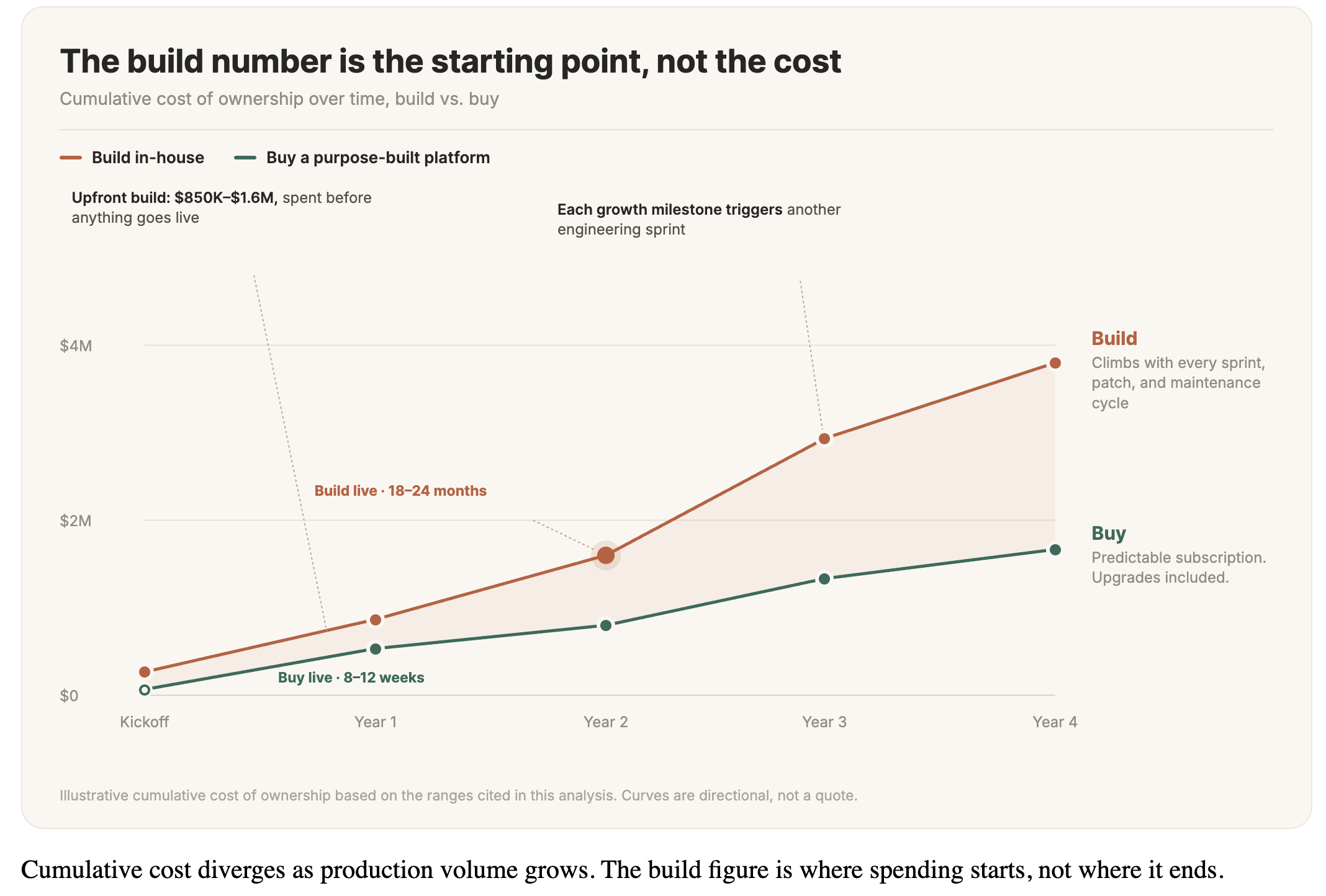
Most teams focus on the upfront software engineering effort and underestimate what comes next. Research shows that nearly a quarter of organizations misestimate AI project costs by 50% or more, with overruns almost always driven by operational expenses that only become visible after a system moves into production. Security patches, integration updates, and onboarding new hires to a one-of-a-kind system add up fast, and every growth milestone triggers another sprint.
A system built for 50 RFQs per month will likely require significant re-engineering at 500. That re-engineering falls on internal developers, and very few hardware-focused manufacturers have the hiring bandwidth, software talent, and execution capacity to do this well while simultaneously scaling their core business.
There is also a meaningful difference between a ‘vibe-coded’ workflow automation and AI architectures that drive strategic sourcing decisions. Purpose-built AI sourcing platforms are not just running automations on top of spreadsheets. They're built on structured supplier data, procurement logic, and workflow state that most internal teams would spend months just assembling the foundation for before writing a single line of sourcing automation.
Most teams underestimate the scaling costs of sourcing and procurement software
Build-vs-buy analyses almost always focus on upfront cost. That's the wrong lens. The whole point of a sourcing and procurement platform is to help you scale production faster. More orders mean more revenue, and more revenue means you need more feature functionality to support the growth you haven't yet experienced. If you've built internally, every new capability requires software engineering capacity. If you've bought, you inherit those upgrades with no lift and no price change.
The build cost is just the starting point
Upfront software engineering hours are visible and easy to scope. Maintenance, security patches, integration updates, and onboarding new team members to a custom system are not. Keeping supplier records structured, indexed, and current is a major infrastructure project most teams don't account for. That data foundation must exist before a single RFQ can go out automatically.
Scaling production means scaling your software too
What works for 50 RFQs per month may break at 500. Supplier performance management functionality that feels optional when you're small becomes critical when you have hundreds of active supplier relationships. Each growth milestone triggers a new software engineering sprint. With a purpose-built platform, that sprint already happened, and the result shipped to every customer.
Upskilling your team on a custom system has a hidden cost
Every new hire needs to learn a one-of-a-kind tool. There's no documentation community, no external support channel, and no shared knowledge base to pull from. When key team members leave, especially those who built or maintained the system, institutional knowledge walks out the door with them. Purpose-built software companies are customer service organizations: they exist to ensure the technology meets your needs and evolves with your team. That is not a capability most manufacturers should be trying to build internally.
Three supply chain realities that stall most internal software builds
- Fragmentation makes it hard to build cleanly
Manufacturing is a fragmented industry when it comes to buying and supplying. The data underneath it is no different. Lead times shift. Prices change. Supplier capabilities, processes, and certifications update constantly. Building a reliable supplier data foundation means not just capturing that information once, but maintaining it as it changes across dozens or hundreds of suppliers. It's hard to trust supplier data when it's spread across multiple systems and is in constant motion. This infrastructure problem stalls most build projects before the sourcing workflow even starts.
- Homegrown workflows are not a defensible moat
In a landscape being reshaped by AI, building custom automations for sourcing and procurement is not a real competitive advantage. Most homegrown workflows rely on external systems like spreadsheets and foundational AI models that every other company has access to. The gap between those tools and purpose-built AI sourcing platforms that drive strategic decision making and power workflow automations grows every day. Building custom is often much harder than teams expect, and the data moat evaporates faster than anyone plans for.
- Most teams aren't considering the product roadmap they're signing up for
Teams evaluating build vs. buy are almost always thinking about the initial buildout. They aren't thinking about what it means to own a product roadmap: allocating software engineering hours, running QA on every update, deploying upgrades without breaking existing workflows, and planning for an evolving business that will need capabilities you can't fully anticipate today. Buying from an external partner means that the roadmap is already built, and every future release ships without an internal sprint.
Can we just retrofit our ERP instead?
This is the objection that comes up most often in mid-market manufacturing evaluations, and it's worth addressing directly.
ERPs are excellent tools for finance teams. They're built for financial transactions: purchase orders, invoices, and general ledgers. They are not built for strategic sourcing execution. Extending an ERP with custom modules for supplier discovery, RFQ management, or bid comparison typically entails expensive and extensive professional services, rigid data models, and a tool that still lacks a supplier network. Sourcing and procurement don't actually live in the ERP; they live in email threads and spreadsheets. Bolting a self-built sourcing layer onto an ERP only adds integration overhead and makes you dependent on your ERP vendor's update schedule.
Sustainment complements your ERP, not replaces it. PO data, master supplier records, and spend reporting stay in the ERP. Sourcing execution, supplier qualification, bid management, and compliance tracking live in Sustainment. They're different jobs. Treating them as one means investing more in a system built for the wrong kind of work. Strategic sourcing software is purpose-built for the execution layer. ERPs are not.
How Sustainment covers the full journey from discovery to delivery
The build-vs-buy question usually starts with sourcing pain: teams trying to automate RFQ sending and track supplier response statuses. But the answer to that question doesn't have to be scoped to sourcing alone. Sustainment covers sourcing, procurement, and supplier management in one platform, so manufacturers don't have to solve sourcing now and figure out the rest later.
One publicly traded energy company came to Sustainment after beginning an internal build. Their team had already dedicated software engineering resources to the project. In a consultative evaluation, what became clear was:
- They had severely underestimated the cost to build versus buy the solution to their challenges
- Their time-to-value would take roughly 8 to 12 times longer by building, an estimated 18 to 24 months, compared to being up and running on Sustainment's platform, fully integrated, in 8 to 12 weeks.
- A total cost of ownership analysis revealed the need for additional headcount to support developing and maintaining their own system, making it harder to scale responsibly
- Even accounting for the fact that their build was still in progress, the gap was telling: the roadmap required to reach quote insights, procurement automation, and centralized supplier management would have taken several quarters more of engineering, all of which Sustainment already delivered and can maintain.
Start with sourcing: RFQ automation and supplier response tracking on day one
Sustainment's AI-native sourcing and procurement platform arrives with a pre-built U.S. supplier network. Sourcing teams can find and qualify suppliers in days, not quarters. RFQ automation and supplier response tracking are live immediately, no data migration project, and no infrastructure build is needed before the first workflow.
Extend into procurement without a second implementation
As sourcing transitions to procurement, Sustainment moves with you. Purchase order management, supplier qualification, and spend visibility are built into the same platform. Original equipment manufacturers and contract manufacturers don't need a second implementation to get procurement coverage because it's already there.
Supplier management built in, not bolted on
Compliance tracking for CMMC, ITAR, ISO certifications, and NDA expiration is built into the platform, not a custom module you maintain. Audit trails, certification alerts, and compliance dashboards come standard. When your production volume grows, new features ship to all customers without a version upgrade, an internal sprint, or a price change. You buy for where you are and inherit the roadmap going forward. Plus, when you partner with Sustainment, roadmap discussions are influenced by the needs of customers.
The build path isn't wrong, it's just slow
There is a version of this decision where building is the right call. If you have a genuinely unique workflow that no platform reflects, and if you have a dedicated software organization with capacity to spare, then owning the build can make sense. Some companies are in that position. The trouble is that most manufacturers evaluating this decision assume they are, and very few actually are. Hardware-focused manufacturers compete on what they build and how well they deliver it, not on the sourcing and procurement software underneath. The software talent that a clean build requires is the same talent those companies are already struggling to hire for the core business. Before committing to build, the honest question isn't "can we build this?" It's "is internal software the thing we want our best engineers spending the next two-plus years on?"
Building isn't an unreasonable instinct. It makes sense to want control, configurability, and ownership over a critical workflow. The issue is a math problem. The manufacturers elevating sourcing fastest are buying purpose-built platforms. Time-to-value is 8 to 12 times faster. Scaling costs are more predictable. And the feature roadmap is already built.
If your team is evaluating sourcing software or asking whether to build, talk to Sustainment before you scope the project. See how fast your team could be running on a platform built for the unique needs of industrial supply chains, not assembled from scratch.
Find out how quickly your sourcing team can go live. Schedule a discovery call with Sustainment.